The first time I had to take a budget seriously, I had just gotten engaged. Once the excitement of the proposal settled, I did the math and there it was: about six months to pay for the wedding I actually wanted without going into debt to get it. That was the moment "I'll figure it out" stopped counting as a plan.
So I built my first real budget. It was clumsy and a little stressful, but it did the job. We had the wedding I wanted, and we started our marriage without a pile of debt waiting on the other side of it.
Then I became a mom, and the stakes quietly climbed again. A budget was no longer just an end goal to one big day on the calendar. It suddenly needed to account for a whole little life I was now responsible for.
If you are sitting in that same spot, managing month to month and quietly wondering where it all goes, this is for you. I want to walk you through how to create a budget as a mom in a way that fits a real life with children in it, not the tidy imaginary life that most budgeting advice seems written for.
Why a budget matters more once you're a mom
A budget is not a punishment. I know it gets sold that way, like a diet for your bank account. What it actually does is tell you the truth, and then hand you a say in it.
Before kids, a messy money month mostly lands on you. After kids, the stakes quietly shift. There are activities you want to be able to say yes to, a cushion you want under your family, and a future you have started thinking about in a way you maybe never did before. If you have ever wondered why budgeting is so important for moms specifically, that is the answer. Budgeting for moms is mostly this: getting your money pointed at the things that matter to you on purpose, instead of by accident.
That is the whole reason it's worth the hour it takes to set up. You stop being surprised by your own life.
Start with one honest month
Before you build anything, you need to see what is actually happening. Not what you think happens. What really happens.
Pull up the last 30 days in your bank account and your cards, and write down where the money went. All of it, including the stuff you would rather not look at. The drive-through snack, the quick Costco trip that was supposed to be paper towels and somehow became $300, the subscriptions you forgot you were paying for. Don't worry, you are not in trouble here. You are just gathering facts.
Then group those expenses into a handful of plain categories. Housing, food, transportation, kids, debt, fun, everything else. Keep it simple enough that you will actually do it.
Most moms I talk to find one or two categories quietly eating far more than they realized. For me it was takeout on the nights I was too tired to cook, which, with little kids, was most nights. Seeing the real number stung. It was also the most useful thing I did, because you cannot fix a number you refuse to look at. Give yourself this one honest month before you judge a single dollar.
Pick a budgeting method that fits your brain
A lot of moms stall out right here, because the internet hands you a dozen systems and implies the problem is you. It isn't. You just haven't found the one that fits how you think. Three that tend to work well for busy parents:
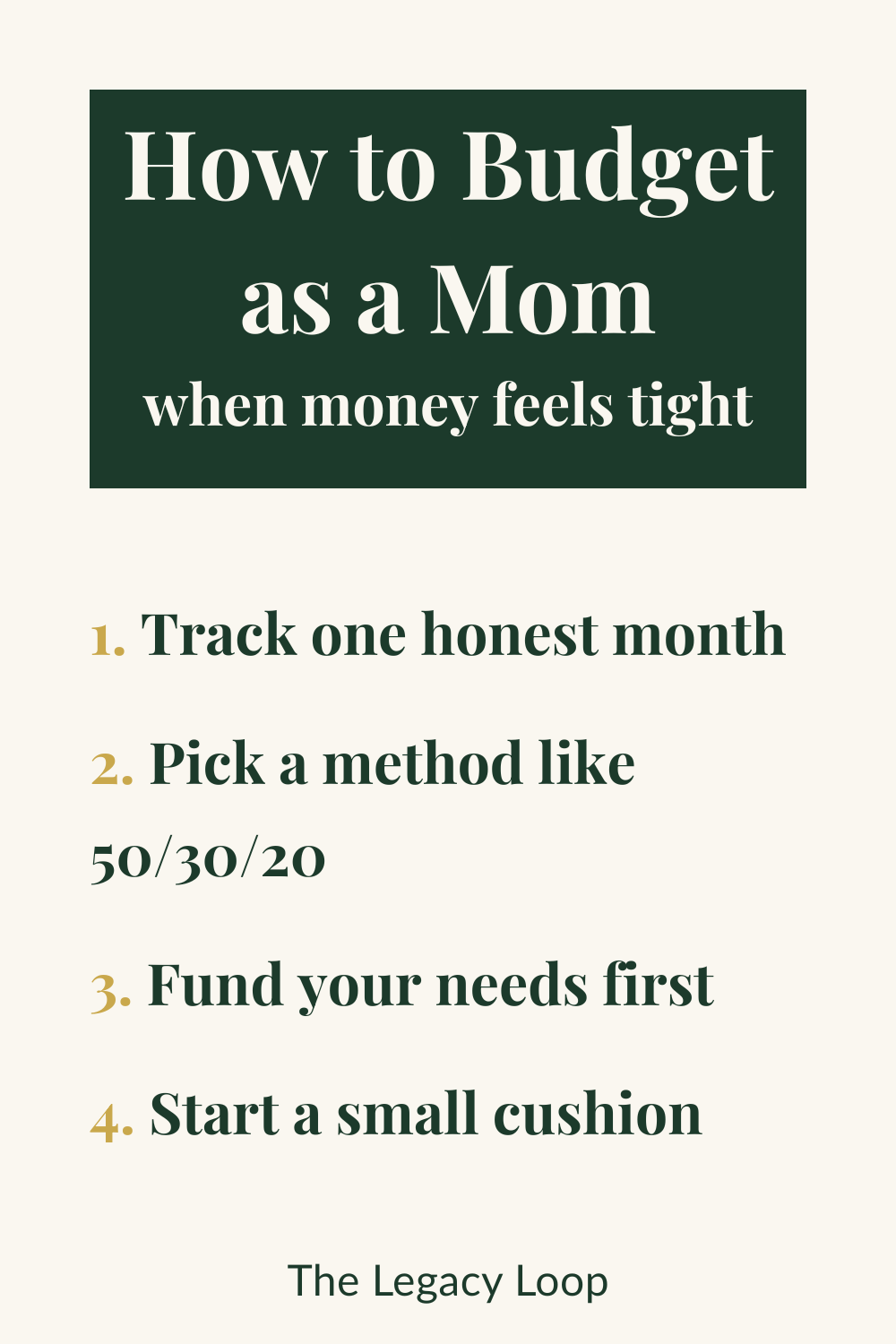
The 50/30/20 rule is the gentlest place to start. You aim to send about half your take-home pay toward needs like housing, groceries, and bills, around 30 percent toward wants, and the last 20 percent toward savings and debt. Those percentages are a starting frame, not a law. If your needs swallow 65 percent right now because childcare is brutal, fine. You adjust the frame to your life, not the other way around.
A zero-based budget runs the opposite way. You give every single dollar a job until nothing is left unassigned, including a job called savings and a job called fun. Some people find it fiddly. Others, especially the planners, feel calmer the moment every dollar has a home.
The cash envelope system is the most hands-on, and it is having a real moment with moms for good reason. You take the categories you tend to overspend, usually groceries and eating out, and pull that money out as cash into labeled envelopes. When the grocery envelope is empty, you are done buying groceries that week. It sounds rigid. In practice it feels weirdly freeing, because the decision is already made and you stop negotiating with yourself in the checkout line.
You do not need the perfect one. Just pick one and run it for a month.
How to budget on one income, or a tight one
If you are running a household on one income, or on two incomes that still feel like one after childcare, the math is tighter and the advice has to be more honest with you.
The first move is to separate the bills that keep the lights on from everything else. Rent or mortgage, utilities, groceries, transportation, insurance, minimum debt payments. These get funded first, every single time, before a dollar goes anywhere fun. On a tight budget, you protect the floor before you decorate the house.
Then look hard at your recurring costs, because that is where one income gets quietly drained. Learning how to save money on a single income has less to do with clipping coupons and more to do with a few bigger levers. The streaming services nobody watches anymore. The phone bill you have never once called to negotiate. The grocery total you can pull down with a loose weekly meal plan and a list you actually stick to. One renegotiated bill will feel a lot better than fifty small acts of self-denial, and it keeps paying you back every month with no further effort.
And to be clear, managing a tight budget does not mean depriving your family. You are deciding, on purpose, which things you will spend freely on and which you will let go, so the money that is left feels like a choice instead of a slow leak.
Build the smallest possible cushion first
Before you reach for anything bigger, build a tiny emergency fund. Not the six months of expenses the finance gurus shout about. That number is paralyzing when money is tight, and a goal that feels impossible is a goal you quit.
Start with a starter cushion instead. Pick a small, real number and get there first. Even a few hundred dollars changes your life when things come up. When the car needs a repair or a kid outgrows their shoes mid-school-year, you handle it without reaching for a credit card and undoing a whole month of careful work. Building an emergency fund on one income is slow going, and that is completely okay. Slow and real still wins over fast and imaginary.
This little cushion is also the hinge your whole financial life turns on. Once it exists, you can stop reacting to every surprise and start building something on purpose. That is where the bigger work starts, and it is more than one guide can hold.
A few mistakes I would skip if I started over
If I could redo my first year of budgeting, I would change a few things. My first budget ran on guesses and vibes, numbers I sort of assumed were right instead of the real ones from an honest month, so it was off from day one. I also made it way too strict, the way any plan that allows zero fun tends to collapse, and I burned out fast. And every time something went wrong, I overcorrected, yanking the whole budget around in reaction instead of making a small tweak. It took me about a year of that before it settled into a system that actually felt comfortable.
You get to skip most of that. Start from a real month instead of a guess, and when something throws you off, nudge the budget instead of tearing it down.
How to actually stick to your budget
A budget you abandon in February is not a failed budget. It is a completely normal one. You will fall off at some point. What matters is how fast you climb back on.
A few things that tend to help moms stick to a budget, from someone who has fallen off plenty. Check in weekly, not daily, because daily tracking burns most people out inside a month, while a 15 minute look on a Sunday is enough to catch trouble early without becoming a second job. Budget for fun on purpose, with a real, named line for treats and outings, so the whole thing never tips into feeling like a sentence. And expect the strange months, because December happens, birthdays happen, and the week a kid needs a field trip payment and a winter coat at the same time happens. A good budget bends for those instead of snapping. You move money around, you adjust, you keep going.
The moms who win at this are not the ones with flawless months. They are the ones who come back to the plan after the messy ones.
Where this goes next
Creating a budget is the first real step, and it is the one most people never quite take, so if you set yours up this week, you are already ahead of where I was for years.
A budget is a snapshot of right now, though. It shows you where your money goes this month. It does not yet show you how to turn those steady dollars into the kind of security and head start you actually want for your kids. That part follows a sequence, and walking you through it one phase at a time is exactly what I built The Legacy Loop to do, from this first budget all the way to passing something on.
When you finish here and you are ready for the full roadmap, that is where I would point you next.
The Legacy Loop shares financial education, not personalized financial advice. Every family's situation is different, so take what fits and talk with a qualified professional for decisions specific to you.